
Go Read Online Full-stack Web Development is gaining traction as the development method of choice among developers looking to create fast, scalable, and efficient web applications. Go or Golang is a modern programming language designed by Google and which is aimed at simplicity and performance. Although it is commonly linked with backend development, Go can be a potent component of full-stack apps, when used alongside the more recent frontend technologies.
Reading online resources can provide flexibility to those learners who need it and enable understanding how Go works and how to use it in practice. The internet offers a lot of information, whether in the form of official documentation or tutorials and guides, to enable you to master full-stack development with Go without necessarily spending money on expensive courses.
An introduction to Go in Full-Stack Development
Go is mostly recognized because of its backend capabilities. It is developed to support high-performance, concurrent processing, and scalable systems. This renders it a great option to develop APIs, microservices, and server-side applications.
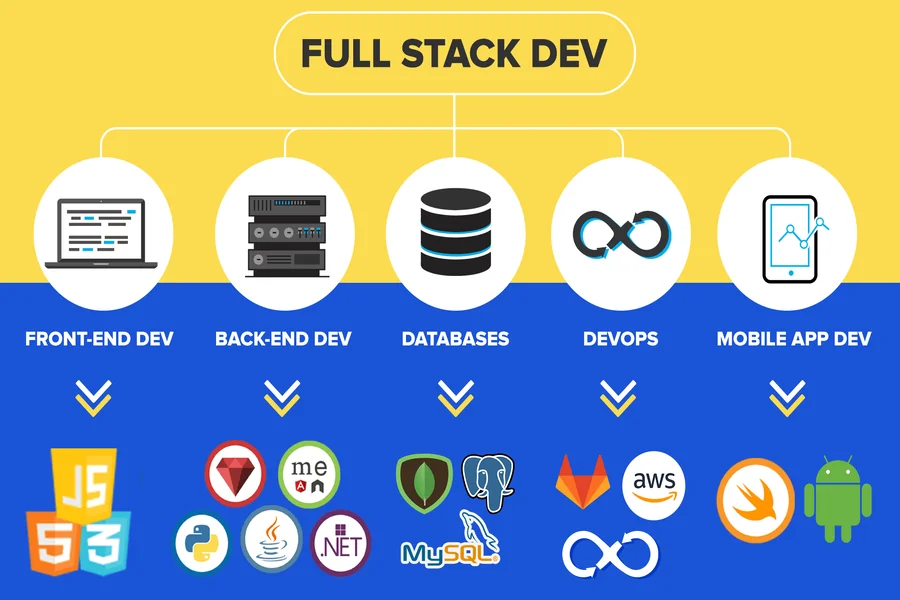
Go is often employed in a full-stack setup to deal with server code, database access, and API endpoints. JavaScript frameworks, such as React, Vue, or Angular, are popular on the frontend. These frameworks are connected to the Go backend by RESTful APIs or GraphQL.
Go is unique in that it is simple. The syntax is concise and user-friendly that assists developers in concentrating on problem resolution and not in addressing complicated features of the language. This ease of maintenance and scaling over time is also brought about by this simplicity.
In Why Choose Go Web Development?
Developers are considering Go to be used in web development projects due to a number of reasons. One of the biggest advantages is performance. Go is written and executed with high efficiency, and is faster than most interpreted languages.
Another significant strength is concurrency. The support of goroutines that Go provides enables developers to support multiple tasks at a time without writing complex code. This is particularly applicable with applications that require processing numerous requests simultaneously.
Go has a good standard library as well. It also contains integrated collections to deal with HTTP requests, JSON and data manipulation, which eliminates the use of third-party dependencies.
Also, Go is very scalable. It is used by large companies to build systems that handle millions of users. This renders it a good option in both small projects and enterprise level application.
Training Go Through Web-based Resources
One of the best methods to learn Go is by reading online resources. The official Go documentation is a good place to start as it has understandable explanations and examples. It includes not only the simple syntax, but also advanced issues.
Numerous tutorials, blogs, and interactive platforms are also available to provide step-by-step instructions. These resources frequently have real-world examples, and thus it is easier to gain insight into how Go is applied in real-world projects.
With online learning, you are in charge of your own learning. You are free to review, do code exercises and create projects along the way. This is particularly helpful in the case of self-educated programmers.
Online learning should be supplemented by practical work to take advantage of it. Attempt to put into practice what you read in developing small applications. This will enable you to be confident and enhance your abilities.
Create Full-Stack Applications in Go
Developing a full-stack app with Go requires a couple of steps. Initially, you have to configure your backend in the Go language. This involves the construction of a server, route definition, and processing requests.
This is followed by connecting your application to a database. Go is compatible with such databases as PostgreSQL, MySQL, and MongoDB. Libraries or ORM tools can be used to manipulate data.
Modern JavaScript frameworks may be used to develop the interactive user interfaces on the frontend. These frameworks interact with the Go backend via APIs and enable you to develop dynamic applications.
Authentication, authorization, and security are also important aspects of full-stack development. Go also has tools and libraries to assist in implementing secure systems.
With experience, you will be able to develop more sophisticated applications, like e-commerce sites, dashboards, or real-time services.
Popular Problems and Ways to solve them
There are hurdles associated with learning full-stack development with Go. Absence of inbuilt frontend tools is one of the common problems. Go does not offer a full frontend solution, as does some other frameworks, and you must combine it with other technologies.
The other problem is the conception of concurrency. Goroutines are potent but may be confusing to novices. The small examples can help you to understand this point better.
Sometimes debugging may also be challenging particularly when dealing with large applications. This could be made easier by using appropriate logging and debugging tools.
Being able to locate resources is overwhelming with the abundance of information on the internet. Dwelling on reliable sources and having a guided learning process are the way to keep up.
It can be overcome with patience and regular effort, and enable you to create efficient and scalable applications.
How to Learn to be a Full-Stack Go Developer
To be a full-stack developer in Go, one should begin with the fundamentals and develop a solid foundation. Get to know the fundamentals of Go, such as syntax and data structures and concurrency.
Get used to it by developing projects. Begin with the basic applications and progress to more complicated ones. It will assist you to learn the manner in which various parts collaborate.
Get familiar with version control software such as Git. This is crucial to regulating your code and work with other people.
Keep abreast of the newest trends and tools in the Go ecosystem. New libraries and frameworks are being created all the time and staying abreast of them will enhance your skills.
Collaborate with the developer community. Join forums, work on open source projects and read other developers.
Consistency is key. The slightest practice every day may result in a great improvement with time.
Final Thought
Full-stack Web Development With Go Read Online is an effective and versatile tutorial that allows developers to create modern web applications. Go is a great backend development language because of its performance, simplicity, and scalability; combined with its compatibility with modern frontend tools, Go offers full-stack development. With the help of online materials, regular practicing, and a strong desire to learn, you will be able to master Go and develop high-quality applications that will fit the requirements of the modern digitalized world.
FAQs
What is Go used for in web development?
Go is used for backend development, including building APIs, handling server logic, and managing databases.
Can Go be used for full-stack development?
Yes, Go can be used for full-stack development when combined with frontend technologies like React or Vue.
Is Go easy to learn for beginners?
Go is considered beginner-friendly due to its simple syntax and clear structure.
Do I need JavaScript with Go?
Yes, JavaScript is typically used for the frontend while Go handles the backend.
How long does it take to learn Go for web development?
It can take a few months to learn the basics and longer to become proficient in full-stack development.
What databases work with Go?
Go works with databases like PostgreSQL, MySQL, MongoDB, and others.
Are there frameworks for Go web development?
Yes, popular frameworks include Gin, Echo, and Beego, which help simplify web development with Go.
