

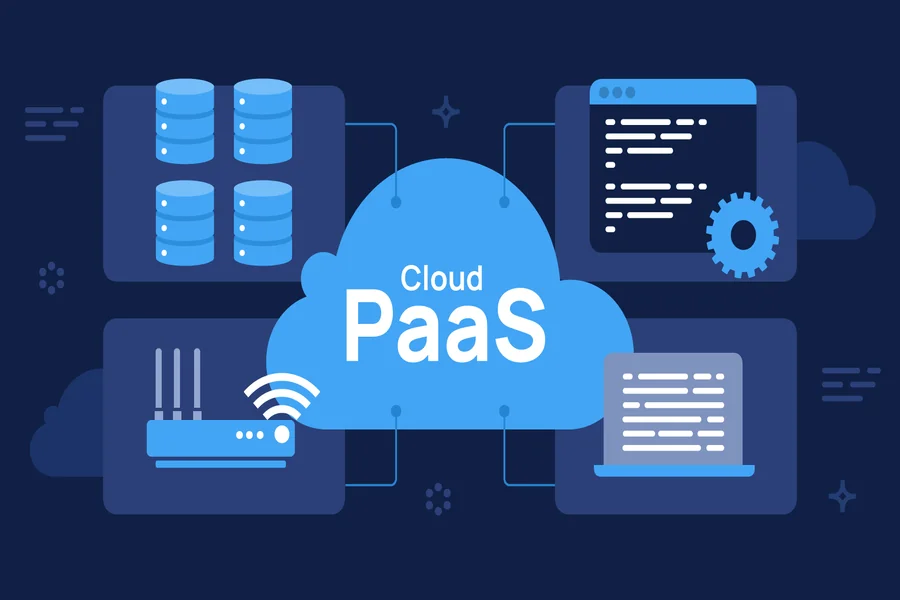
Platform As A Service In Cloud Computing has emerged as a significant part of the contemporary application development. Companies no longer have to be concerned with hardware, operating systems or complicated infrastructure. They can rather concentrate on the effective development, testing and implementation of applications. This has not only contributed to cost reduction, but also spurred innovation in industries.
As the need to develop scalable and flexible solutions demands increase, PaaS provides the developers with a powerful environment to develop applications in a short time. No matter whether you are a startup or a large organization, this model and its functionality can greatly enhance your development process and business dynamics.
What Is Platform As A Service (PaaS)?
A Platform as a Service is a type of cloud computing where the developer will be given a pre-made platform. It contains all the elements necessary to create applications including operating systems, development tools, databases and middleware. In contrast to the conventional type of hosting, servers and storage do not need to be managed manually by the user.
This model falls in between Infrastructure as a Service (IaaS) and Software as a Service (SaaS). When you have IaaS, where you have control of the infrastructure and SaaS where you have fully functioning software, PaaS act as an in between and offers a managed environment to develop with.
The developers need not bother with maintaining the systems and can just log on, code and deploy. This renders PaaS extremely efficient and user-friendly.
The most important characteristics of PaaS
The rich set of features tailored to ease the development processes is one of the most appealing features of PaaS.
First, it has in-built development tools that facilitate several programming languages. This gives freedom to the teams to operate in their favorable coding environment.
Second, a fundamental feature is scalability. Scaling can be easily done up or down based on the user demand in the application. This guarantees the maximum performance without wastage of resources.
Automation is another key aspect. The service provider also does the work of updates, backups and security patches automatically and this consumes less man power.
Also, PaaS allows teamwork. Several developers can be involved with the same project at the same time and this enhances productivity and accelerates the development cycles.
The advantages of PaaS usage in cloud computing
The advantages of adopting PaaS go beyond convenience. It has the potential to change the way organizations create and provide software.
Cost efficiency is one of them. Businesses will be able to save huge amounts of money on hardware and infrastructure expenses since they will not be required to make the upfront investment. they can only pay what they consume.
The other benefit is quicker time to market. Application developers are able to develop, test, and deploy applications fast without the delay associated with the infrastructure configuration.
PaaS also enhances flexibility. The platform enables teams to work remotely without difficulty since it is accessible anywhere.
Another advantage is security. The majority of PaaS vendors offer the following security measures: data encryption, access control, and compliance.
Lastly, it encourages innovation. Removing the technical barrier, developers can be creative and concentrate on solutions instead of managing the system.
Popular PaaS Uses
PaaS is utilized in various sectors with a variety of purposes. A typical application is the development of web applications. Ready-to-use environments allow developers to develop and deploy websites within a short time.
Mobile app development is another trendy application. PaaS offers services and platforms that make it easier to develop apps across a variety of platforms.
It has also been implemented in API development and management. Without the need to handle complexities in the back-end, business can develop and operate APIs effectively.
Also, PaaS allows data analytics applications. Companies are able to process data in high volumes and make insights without the need to maintain data bases manually.
PaaS also assists devops teams in automation of workflow and enhanced cooperation between the development and operations teams.
Obstacles and drawbacks of PaaS
Although PaaS has numerous benefits, it does not come without its challenges.
A downside is a diminished control. The provider controls the infrastructure used hence the user cannot vary it too much. Applications that have particular requirements can be a problem with this.
Another thing is vendor lock-in. It may be cumbersome and time-consuming to migrate applications between one provider to another.
The performance can also be affected in case the platform has a downtime or technical inconveniences. A business is very dependent on the reliability of the provider.
There can also be issues related to security, particularly when dealing with sensitive data. Even though there are security measures provided, users should still adhere to the best practices.
Finally, compatibility problems can arise when some programming languages or programs are not compatible with the platform.
Popular PaaS Providers
Some of the largest organizations provide PaaS which address varying business requirements.
Google App Engine has been characterized by being scalable and having support of various programming languages. It suits well those developers who want to have an elastic and robust platform.
Microsoft Azure App service can be easily integrated with other Microsoft products thus making it an excellent selection in the case of businesses that are already utilizing Microsoft products.
AWS Elastic Beanstalk is an application with a high-level support of Amazon Web Services that can be deployed and managed easily.
Another more popular solution is Heroku, particularly used by startups as simple and friendly to developers.
All the providers have their advantages, and it will be necessary to select the one that suits your needs and objectives.
Final Thought
Cloud Computing The Platform As A Service is changing the way applications are developed and deployed. It does away with the infrastructure management complexities and enables developers to concentrate on innovation. Although it has certain drawbacks, the advantages tend to supersede the setbacks of most businesses.
Due to the ongoing technological changes, PaaS is expected to become even more significant to the digital transformation. This model allows organizations to gain a competitive advantage because those that embrace this model early will be in a position to develop and deploy applications more quickly and efficiently.
FAQs
- What is Platform As A Service in simple terms?
It is a cloud service that provides a complete environment for building and running applications without managing hardware or infrastructure. - How is PaaS different from SaaS?
PaaS provides a platform for developers to create applications, while SaaS delivers ready-to-use software to end users. - Is PaaS suitable for small businesses?
Yes, it is cost-effective and easy to use, making it ideal for small businesses and startups. - Can I scale applications easily with PaaS?
Yes, scalability is one of its main advantages, allowing applications to handle varying workloads efficiently. - What are the risks of using PaaS?
Some risks include vendor lock-in, limited control, and potential security concerns, but these can be managed with proper planning.
